

(A gory little fanfiction – based around the Tobe Hooper film “The Funhouse”)
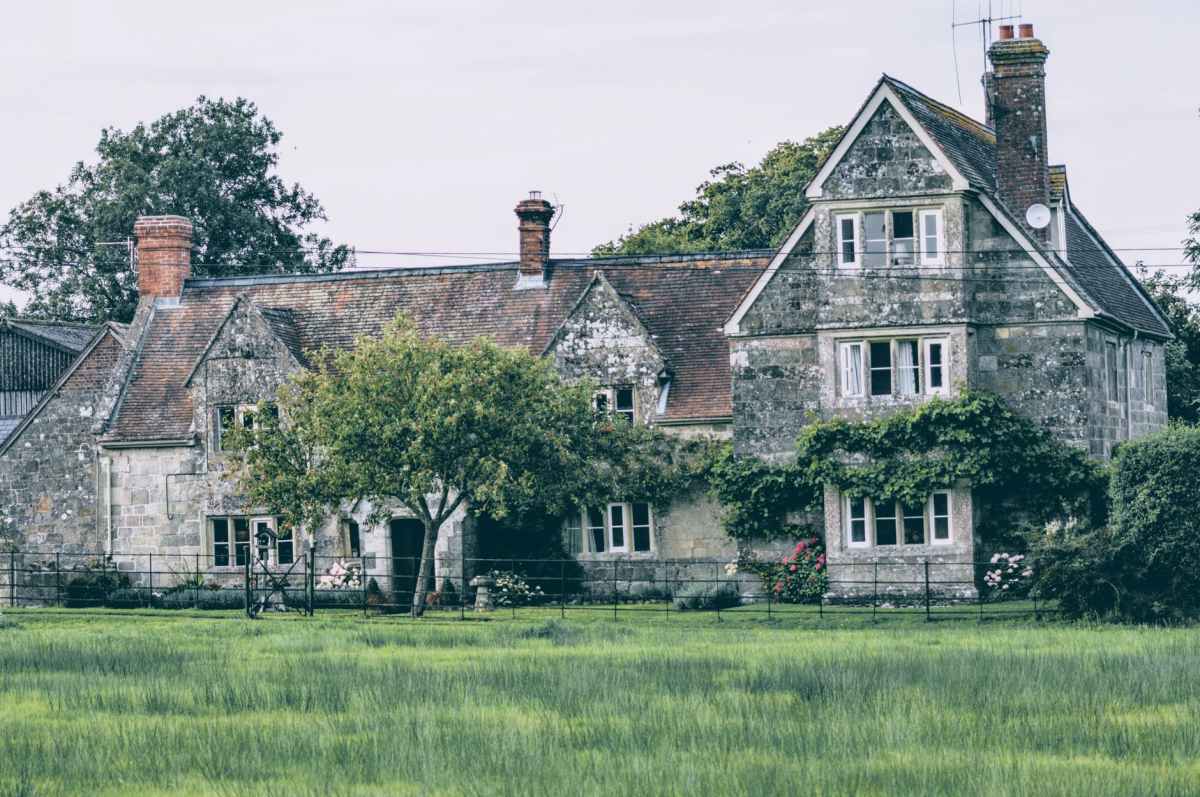
We can see the house from the barn. It sits at the end of a snow-dusted driveway that’s riddled with cracks and weeds. The trees grow against the ivy-covered walls, keeping the winter sunlight away from its black windows. The house is haunted, of course. Why else would it be relegated to the deepest part of the woods? Shunned and abandoned, while tormented things wander its hallways. The barn sits behind the house, a cavernous shell of rotting timbers and rusted brackets. Wicked looking tools hang from hooks and rust like dried blood flakes from the blades. Carousel horses stand wild-eyed in the otherwise empty stalls and we imagine we hear the off-key tones of a calliope drifting in with the breeze.
We watch as a car pulls into the driveway. It moves slowly, hesitantly and sits silently when it stops, as if taking a breath or collecting itself—reflecting on recent trauma, perhaps. And, yes, as it turns out, there was a near-miss on the way here. We will the car to turn back, leave the house and get back on the highway. But the family is already tumbling from the car into the fast fading light of late afternoon. The father is first, stumbling from the passenger side, shuffling through the thin layer of snow and lighting a cigarette with one shuddery hand while shielding the flame of his lighter with the other. Teenaged daughter and younger-by-three-years son are next, ejected from the backseat, one from each side of the car. The girl—a compact package of angst and complicated emotions—stands, hands on hips, snapping gum and sucking teeth as she stares at the house. The boy, put on this earth solely to annoy his older-by-three-years sister stands in the shadow of the trees. He is thanking God he didn’t actually wet his pants when the blue car with the “coexist” sticker on the bumper came out of nowhere at about a million miles an hour. He’s also thanking God that his mother was driving and not his dad, because his dad sometimes drinks too much beer with breakfast and he’s never what you would call “present”. The boy screamed when the car appeared and missed them by barely a breath. He couldn’t distinguish his scream from his mother’s, the two sounds wrapped up in one another. He knows his sister, who remained strangely silent, will tease him about it later. The boy stands with his back to the trees, the darkness heavy on his back. He steps closer to the car and now he sees his mother through the window. She is sitting in the driver’s seat, hands grasping the steering wheel at a sensible ten-to-two, her face set in a grimace. Her mouth is moving, she’s talking to herself. But then she notices the boy and turns her grimace into the best impression of a smile she can manage. The boy opens her door.
“Mom?”
She looks up at him and sighs. “Are you okay, Robbie?” she asks. “Close call, huh?”
He nods and swallows, steps back to make room as she unfastens her seatbelt and gets out of the car. She rubs his arm—warily, it seems. As if the door between her son’s childhood and adolescence is rigged with a tripwire that will snap it shut at the slightest touch. She sees her daughter glaring at the ivy-covered house. She sees her husband, sucking the life from the cigarette he has pinched between forefinger and thumb. The embers at the end of the cigarette glow for a second, then fade—a heartbeat of fire.
“Seriously, James?” she asks and brushes by him.
He frowns at her, beer-scented breath forming clouds in the icy air. It’s Jimmy, not James, but we understand, even if James doesn’t, that she uses that name to push buttons. But we also understand that him smoking right now is pushing all of hers.
“Put the damn cigarette out and get the tree,” she says and turns to Robbie, her voice softening considerably. “Robbie, help your dad with the tree, hun.”
We take note of the way Robbie glances at his dad and the way his dad lingers over the last deep drag of the cigarette. The two men of the family unhook the bungee cords that hold the pine tree on the roof of the car. Robbie’s mom rummages through her purse for the keys to the door, while his sister rolls her eyes and scoffs.
“What even is this place?” she asks. “Why couldn’t we stay in a motel? This place is for shit.”
“Rebecca,” her mother scolds and brandishes the key, finally, from the depths of her purse. She pushes the door and, just as we suspected, it creaks ominously open onto a cobwebbed hallway. “It’ll be fine,” she says. “And it’s free. Maggie was nice enough to let us stay here for Christmas.”
“It’s a shit heap,” Rebecca says.
“Did Captain Obvious come along for the ride?” The dad smirks at Rebecca as he and Robbie lug the tree through the doorway.
“Try to be nice for the next few days,” says the mom—whether it’s aimed at Rebecca or Jimmy-not-James, we can’t be sure. She follows her husband and son and the Christmas tree into the house.
*
It’s cold in the house. The floors are dusty and mold fingers its way along the walls. There’s a large room off the hallway, with a working fireplace. It’s as good a place as any to put the tree and settle for the evening. Rebecca and Robbie are sent back outside to get the luggage from the trunk of the car. Rebecca stands next to the car while her brother lifts out the bags of clothes and presents and Christmas decorations. Her body radiates annoyance.
“What do you think’s in the barn?” asks Robbie, pointing behind the house.
“How would I know?” asks Rebecca. She grabs bags and heads back to the house.
Robbie stays outside for a minute and hovers between wanting to get inside to the relative comfort of his family and the desire to explore. Familiarity and the promise of food wins over, for now, and he follows his sister.
Robbie doesn’t see the shadow moving between the slats of the rotting boards of the barn. He doesn’t know there’s someone watching from the dark, touching the peeling paint of the carousel horses, testing the blades of the scythes and saws.
His mother has set up camp in the kitchen, lighting the stove and sorting through cabinets for pots and pans. She smiles at Robbie when he puts a box of food on the table.
“Is this all we brought?” Robbie wants to know, eyeing the boxes of pasta and rice-a-roni, the crackers and tins of various soups and vegetables.
“For now,” his mother says. “We can shop tomorrow for Christmas dinner. We passed a grocery store on the way up here.”
“When?” Robbie wrinkles his nose and tries to recall anything before the near-miss with the blue car. “You mean that little deli?”
His mother shrugs and starts unloading the box of food. “Why don’t you see if you can find some Christmas decorations?” she says. “If you’re brave enough to explore the attic…or basement.” She wiggles her eyebrows at Robbie—a dare.
“There’s a barn,” says Robbie. “Might be in there.”
“Sure. Go and look. Take a flashlight.”
*
The flashlight does nothing to light up the interior of the barn. Its beam swings back and forth, catching a section of wall here with dangerous looking farm tools dangling from hooks and a stall there with the wild-eyed infinite stare of a life-sized tin horse. Robbie creeps forward, disturbing the scrawny rats that live there. He yelps as one runs across his boot. The horses are seriously creeping him out, but he wants to find something to bring back for his mother. The wind picks up outside and Robbie hears the strains of carnival music. He thinks, not of cotton candy or the ferris wheel, but of long dark halls of warped mirrors. He swings the flashlight around and jumps as a face looms—sharp teeth set in a crooked mouth, sparse grey hair and red eyes—as suddenly as it appeared, it’s gone. Robbie tries to catch his breath and slow his heart. He points the flashlight again, but there’s no-one there. He takes one more look around and walks quickly from the barn into the cold night. He runs across the barnyard to the house, imagining a nightmare snapping at his heels.
Robbie’s mom is in the kitchen. His dad is kicked back in a ratty armchair in front of the fire, drinking what is most likely his tenth or fiftieth beer of the day. Rebecca is sorting through the few decorations they brought from home. She looks up when Robbie comes in.
“Find anything?” she asks.
Robbie shakes his head and joins her next to the box of decorations from Christmases past.
“Whose house is this?” he asks.
Rebecca shrugs, already bored of Robbie’s company. She gets up and tours the room, opening random drawers in the built-in dresser and the damp-swollen desk beneath the window.
“It belonged to a distant cousin of a friend of a friend of your mom’s. Or some such shit.” Robbie’s dad lifts his beer bottle in a cheers gesture to the room in general. “You know the deal. No close relatives, cousin died and left his hoarder-mansion to the next on the list. She doesn’t want it, can’t be assed to sell it, no-one would buy the shit-heap anyway. Blah blah blah and here we are. Merry fucking Christmas.”
Rebecca holds up a book she’s found in one of the drawers. A photo album.
“Found something,” she announces. Robbie looks up. Their dad has lost interest and is staring into the flames, nursing the lukewarm remains of his beer.
“What is it?” asks Robbie.
“Photos.” Rebecca flicks through the pages. “Looks like they were carnival people. They’re all old-timey pictures of a fairground.” She turns the album, so Robbie can see. “Madame Zena. Looks like a fortune-teller.”
“Who’s that?” Robbie points at a man in what he would call a ringmaster’s suit.
Rebecca squints at the spider-like handwriting beneath the picture. “Oh my God! It’s Conrad Straker.”
“Who?”
“The carnival guy who lost his shit and chopped up those teenagers.” Rebecca is looking at Robbie, waiting for him to remember, rolls her eyes when he doesn’t. “You know. Those kids who stayed overnight at the fair, got murdered in horrendous ways. No, wait…” She frowns, looks like she’s staring out the window into the darkness. “There was one girl who survived. Annie? No, Amy.”
Robbie wants to be with his mother in the warm kitchen, not here with his drunk father and his morbid sister. Just as he’s about to walk out, a scream rips through the house. Rebecca drops the photo album and the siblings run into the hallway to see what’s going on. Robbie will wonder later, as he’s stumbling through the woods, blood-soaked and sobbing, why they ran towards that scream. The scream is impossibly loud and goes on for longer than Robbie thinks it should, until it comes to a sudden, gurgling end. Rebecca takes up where it leaves off and Robbie turns to see why. His mother is pinned to the wooden kitchen table, blood drips onto the floor from where the cleaver has pierced her chest. Robbie has a second to wonder how strong someone would have to be to do that. He thinks, randomly, of a strong man at a carnival. And there’s the calliope again, seeping into the house through cracks in the eaves and door jambs. And above it all, Rebecca is still screaming.
Out into the night, the pale moon shivers behind thready clouds. Robbie’s breath comes in gasps of white. He holds tight to Rebecca’s hand as he pulls her into the woods.
“What about Dad?” Rebecca’s face is covered in tears and snot. Something he can use against her when they’re on the other side of this night. He doesn’t want to tell his sister, when they ran past the great room, their dad was headfirst in the fireplace, axe handle jutting from his back. The floor was already steeped in blood.
“Be quiet!” They stand beneath the cover of the trees. A shape emerges from the house, makes a quick dash across to the barn.
“Who is that?” asks Rebecca.
“I don’t know,” says Robbie, tears dangerously close.
Neither Rebecca nor Robbie see the figure fly from the barn into the woods. Thinking they’re safe for the moment, they stay in the shadows, not knowing what to do next. Their father had complained endlessly on the drive up here that cell service was spotty. And even if 5G was available up here in Shitsville, it wouldn’t matter anyway—Rebecca’s phone is in her bag in the room where Jimmy-not-James is bowing to the god of cinders. He won’t be rising from the ashes any time soon. And Robbie hasn’t got a phone.
“We should go, probably,” Rebecca says and nods her head furiously, agreeing with her own assessment of the situation. She stumbles away from Robbie, disappearing into the gloom before Robbie can stop her.
“Becca,” he shouts, reverting to the name he gave her when he was smaller and she still liked him.
“Robbie!”
He starts towards the sound of her voice, then stops at the silence that follows. There’s the nasal whistling of the breeze through the trees, the scurrying of something small in the dead leaves, and a creaking. Something is creaking in the branches above Robbie’s head. Something heavy that swings back and forth and back and forth. There’s a drip on Robbie’s upturned face. Then another and another. He can’t see into the blackness, it’s so dense he can feel it pressing down on his eyes. He touches the wetness on his cheek—it’s thick and smells coppery. More drops rain down, faster and faster. The creaking thing falls and becomes Rebecca crumpled on the forest floor at his feet.
“Becca! Becca! Becca!” And he runs.
*
Robbie feels as if he’s been running for hours, his legs are burning and his chest hurts with every breath he pulls in. But the moon is still floating on wisps of tired clouds and the forest is still as black as pitch on a midnight road. He sees a break in the trees and realizes, a second too late, that the ground also comes to an end here. He falls down a slope covered in mouldering leaves and patches of snow and lands on icy tarmac. He jumps to his feet and limps along the side of the road, constantly checking back over his shoulder, not ready to believe he could possibly be away from danger. A car’s headlights blink into being in the distance and Robbie shields his eyes as it approaches. He waves his arms above his head and we’ll forgive him for not recognizing the blue paintwork or the “coexist” sticker on the bumper. It is, after all, on the back of the car and he’s pinpointed by its full beams in front.
“Hey, hey,” he sobs, his throat feels hoarse and he wonders if he’s been screaming.
The car slows and stops beside him, its tires crunching in the gutter. The window powers down and a woman leans out.
“You okay?” she asks.
“I need to get to town. To the police. I need the police. An ambulance. My family. Oh God. My sister, she was…my mom…”
“Okay, okay. Hey, calm down. It’s okay, yeah? Come on, get in. I’ll drive you.”
Robbie hesitates, has watched enough horror scenes from behind the couch to know how the hitchhiker on a quiet country road winds up. Usually suspended from a rusty hook in the basement. But the walk back to town is long and he doesn’t want to be out in the open with whoever, or whatever, is killing his family. And he doesn’t have a coat. He jogs to the passenger side of the car and opens the door. The woman smiles at him and as she pulls back into the road it occurs to him that the car is blue.
“I’m Amy,” the woman says. And they drive into the night. It takes a full five minutes for Robbie to realize they’re heading back up to the house. Somewhere inside he marvels at how far he managed to get through the woods. He panics and tries to open the door, but it’s locked and in his frenzy he forgets how to unlock a car from the inside.
We watch as the car pulls into the driveway. There’s nothing slow or hesitant about it, although it’s seen its share of trauma. We thought Robbie would be the one to get away—hoped he would live to tell the tale. But he’ll join us behind the barn and watch with us as other families come and go and listen as the breeze carries with it the faint notes of the calliope. Hear them? Try to ignore the screams.

Photo by <a href=”https://stockcake.com/i/eerie-carousel-scene_674438_134196″>Stockcake</a>




 Write Josephine Write